
What an impurity is
For the ICH guidelines, an impurity is any component of the drug substance that is not the substance itself. The guidelines split them into three groups:
- Organic impurities: starting materials and synthesis intermediates, by-products, degradation products (ICH Q3A for drug substances, ICH Q3B for finished products).
- Inorganic impurities: reagents, catalysts, inorganic salts and elements, the latter covered by ICH Q3D.
- Residual solvents, covered by ICH Q3C.
Paracetamol is a good example. Its monograph in the European Pharmacopoeia labels the impurities with a letter: impurity K, for instance, is 4-aminophenol, which is both a synthesis intermediate and the product of paracetamol degradation by hydrolysis.
The thresholds: when an impurity must be reported, identified, qualified
ICH Q3A(R2) sets three thresholds, which depend on the maximum daily dose of the active substance:
| Threshold | Maximum daily dose up to 2 g | Maximum daily dose above 2 g |
|---|---|---|
| Reporting | 0.05% | 0.03% |
| Identification | 0.10% or 1.0 mg per day (whichever is lower) | 0.05% |
| Qualification | 0.15% or 1.0 mg per day (whichever is lower) | 0.05% |
Above the identification threshold the structure of the impurity must be known; above the qualification threshold you need data showing it is safe at the stated level. To confirm an identity and measure such low concentrations you need the standard of that impurity.
In the European Pharmacopoeia the same principles are set out in the general monograph Substances for pharmaceutical use (2034) and in chapter 5.10. In the monograph of each substance, the Impurities section separates the specified impurities, each with its own limit, from the other detectable impurities.
Two special cases. Mutagenic impurities follow ICH M7, with a threshold of 1.5 µg per day for lifetime exposure. For nitrosamines, since 2019 EMA has asked marketing authorisation holders to evaluate the risk in every medicine and, where needed, to confirm it with highly sensitive testing.
The types of standard you need
The same active substance may call for different standards, depending on the job. The paracetamol family in our catalogue has all of them:
API
The active substance
For identification, assay and system suitability.
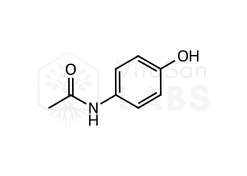 ParacetamolCat. No. P-P017-001
Pharmacopoeial impurity
Pharmacopoeial impurities
The lettered ones in the EP or USP monograph: for the monograph tests and method validation.
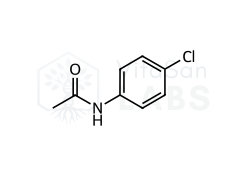 Paracetamol EP Impurity JCat. No. P-P017-011
Impurity
Other impurities
Process and degradation impurities not listed in the monograph: useful in development, stability studies and in-house methods.
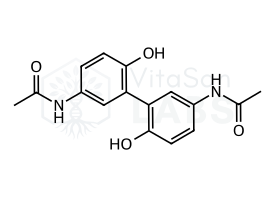 Paracetamol DimerCat. No. P-P017-036
Nitrosamine
Nitrosamines
For risk evaluation and confirmatory testing.
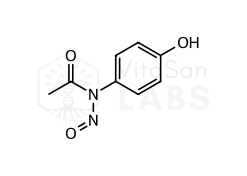 N-Nitroso ParacetamolCat. No. P-P017-025
Metabolite
Metabolites
For bioanalysis and pharmacokinetic studies.
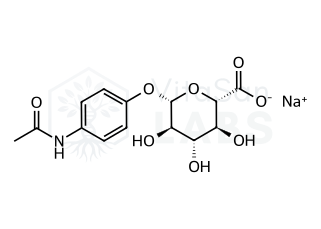 Paracetamol Glucuronide Sodium SaltCat. No. P-P017-017
Labelled
Stable isotope labelled
Internal standards for LC-MS methods.
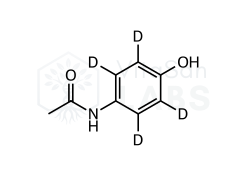 Paracetamol-d4Cat. No. P-P017-023
Where the monograph prescribes it, the official European Pharmacopoeia standard (CRS) is used for the tests in which it is stated: for paracetamol, for example, Paracetamol CRS and Paracetamol impurity J CRS.
How to choose: five questions
- What do you need it for? For a monograph test that prescribes a CRS, use the CRS. To develop and validate a method, for impurities with no official standard and for everyday work you need a well characterised standard, with the documentation that justifies its use.
- Is the identity confirmed by more than one technique? One spectrum is not enough: look for IR, mass spectrometry, 1H-NMR and 13C-NMR.
- Is purity enough, or do you need the assay? HPLC purity tells you how clean the substance is relative to what the detector sees. For a quantitative measurement you need an assigned assay: mass balance starts from chromatographic purity and subtracts water, residual solvents and inorganic residue; qNMR measures the assay directly, with a method independent of chromatography.
- Will you use it as an in-house primary standard? When no standard from an official source exists, ICH Q7 (paragraphs 11.17 and 11.18) requires an in-house primary standard to be established, with identity and purity fully established and documented. Here what counts is an assay measured with an orthogonal method, such as qNMR.
- Does the documentation come with every lot? The certificate of analysis should report the identity, purity and assay of the lot, with the supporting spectra and chromatograms.
Our pharmaceutical standards come in two characterisation levels: Level 1, with the assay by mass balance, and Level 2, with the assay by qNMR and the documentation for qualification as an in-house primary standard (for small molecules). The full comparison is on every product page.
Sources
- ICH Q3A(R2), Impurities in New Drug Substances (2006)
- ICH Q3B(R2), Impurities in New Drug Products (2006)
- ICH Q3C and Q3D, residual solvents and elemental impurities
- ICH M7(R2), mutagenic impurities (2023)
- ICH Q7, GMP for active pharmaceutical ingredients, paragraphs 11.17 and 11.18
- European Pharmacopoeia, general monograph 2034 and chapter 5.10
- EMA, nitrosamine impurities: guidance for marketing authorisation holders