
 Particle size standards20 nmNanoStandards™ Particle Size Standard 20 nmCat. No. 10020-20Pack size 20 mLPrice
Pharmaceutical analytical standards
Particle size standards.
Reference materials to calibrate and verify particle counters, particle sizing instruments and cytometers: polystyrene and glass microspheres, count controls for USP <788> and <729>, fluorescent microspheres and zeta potential controls. List prices are shown after signing in to the customer area.
Particle size standards 43
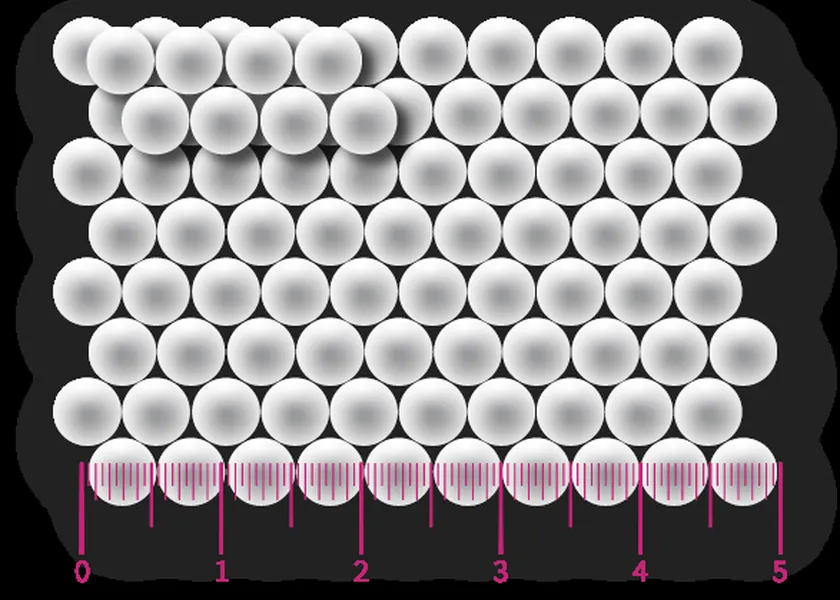
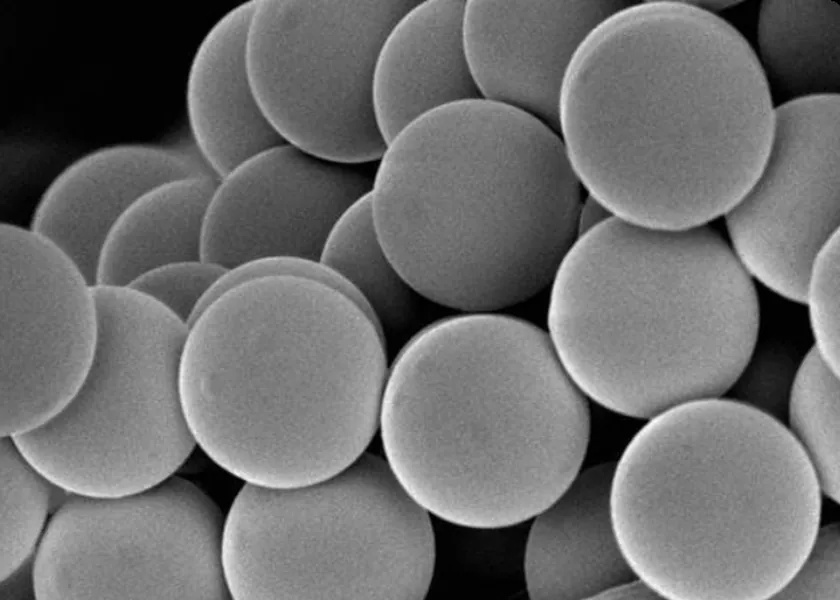
Monodisperse polymer (polystyrene) microsphere suspensions to calibrate and verify instruments that measure particle size and number. The diameter is calibrated by electron and optical microscopy and confirmed with several independent methods (ESZ, SPOS, ADC, laser diffraction, DLS); traceability to NIST and to the SI metre runs through materials calibrated in an ISO/IEC 17025 accredited laboratory. Every lot has its own certificate with mean diameter, standard deviation and expanded uncertainty. NanoStandards from 20 to 990 nm and MicroStandards from 1 to 200 µm, in 20 mL dropper bottles stored at room temperature.
Series technical data
| Material | Monodisperse polymer (polystyrene) microspheres |
|---|---|
| Form | Aqueous suspension |
| Medium | Water with traces of an antimicrobial agent and a surfactant for colloidal stability |
| Diameters | NanoStandards 20-990 nm; MicroStandards 1-200 µm |
| Concentration (solids) | 1% up to 9 µm (w/v for NanoStandards); 2% from 10 to 90 µm; 3% from 100 to 200 µm |
| Pack | 20 mL dropper bottle |
| Traceability | NIST (unbroken chain of measurements to NIST SRMs) and SI (metre), through reference materials calibrated by an ISO/IEC 17025 accredited laboratory |
| Diameter calibration | Electron (TEM, SEM) and optical microscopy, confirmed by orthogonal methods: ESZ, SPOS, ADC, laser diffraction, DLS |
| Lot certificate | Certified mean diameter, standard deviation, expanded uncertainty |
| Shelf life | 36 months from the date of manufacture |
| Storage | Room temperature (4-30 °C) |
Particle size standards20 nmNanoStandards™ Particle Size Standard 20 nmCat. No. 10020-20Pack size 20 mLPrice Particle size standards50 nmNanoStandards™ Particle Size Standard 50 nmCat. No. 10050-20Pack size 20 mLPrice Particle size standards80 nmNanoStandards™ Particle Size Standard 80 nmCat. No. 10080-20Pack size 20 mLPrice Particle size standards100 nmNanoStandards™ Particle Size Standard 100 nmCat. No. 10100-20Pack size 20 mLPrice Particle size standards150 nmNanoStandards™ Particle Size Standard 150 nmCat. No. 10150-20Pack size 20 mLPrice Particle size standards200 nmNanoStandards™ Particle Size Standard 200 nmCat. No. 10200-20Pack size 20 mLPrice Particle size standards250 nmNanoStandards™ Particle Size Standard 250 nmCat. No. 10250-20Pack size 20 mLPrice Particle size standards300 nmNanoStandards™ Particle Size Standard 300 nmCat. No. 10300-20Pack size 20 mLPrice Particle size standards350 nmNanoStandards™ Particle Size Standard 350 nmCat. No. 10350-20Pack size 20 mLPrice Particle size standards400 nmNanoStandards™ Particle Size Standard 400 nmCat. No. 10400-20Pack size 20 mLPrice Particle size standards500 nmNanoStandards™ Particle Size Standard 500 nmCat. No. 10500-20Pack size 20 mLPrice Particle size standards600 nmNanoStandards™ Particle Size Standard 600 nmCat. No. 10600-20Pack size 20 mLPrice Particle size standards700 nmNanoStandards™ Particle Size Standard 700 nmCat. No. 10700-20Pack size 20 mLPrice Particle size standards800 nmNanoStandards™ Particle Size Standard 800 nmCat. No. 10800-20Pack size 20 mLPrice Particle size standards900 nmNanoStandards™ Particle Size Standard 900 nmCat. No. 10900-20Pack size 20 mLPrice Particle size standards990 nmNanoStandards™ Particle Size Standard 990 nmCat. No. 10990-20Pack size 20 mLPrice Particle size standards1 µmMicroStandards™ Particle Size Standard 1 µmCat. No. 11010-20Pack size 20 mLPrice Particle size standards1.33 µmMicroStandards™ Particle Size Standard 1.33 µmCat. No. 11013-20Pack size 20 mLPrice Particle size standards1.5 µmMicroStandards™ Particle Size Standard 1.5 µmCat. No. 11015-20Pack size 20 mLPrice Particle size standards2 µmMicroStandards™ Particle Size Standard 2 µmCat. No. 11020-20Pack size 20 mLPrice Particle size standards2.5 µmMicroStandards™ Particle Size Standard 2.5 µmCat. No. 11025-20Pack size 20 mLPrice Particle size standards3 µmMicroStandards™ Particle Size Standard 3 µmCat. No. 11030-20Pack size 20 mLPrice Particle size standards4 µmMicroStandards™ Particle Size Standard 4 µmCat. No. 11040-20Pack size 20 mLPrice Particle size standards5 µmMicroStandards™ Particle Size Standard 5 µmCat. No. 11050-20Pack size 20 mLPrice Particle size standards6 µmMicroStandards™ Particle Size Standard 6 µmCat. No. 11060-20Pack size 20 mLPrice Particle size standards7 µmMicroStandards™ Particle Size Standard 7 µmCat. No. 11070-20Pack size 20 mLPrice Particle size standards8 µmMicroStandards™ Particle Size Standard 8 µmCat. No. 11080-20Pack size 20 mLPrice Particle size standards9 µmMicroStandards™ Particle Size Standard 9 µmCat. No. 11090-20Pack size 20 mLPrice Particle size standards10 µmMicroStandards™ Particle Size Standard 10 µmCat. No. 11100-20Pack size 20 mLPrice Particle size standards15 µmMicroStandards™ Particle Size Standard 15 µmCat. No. 11150-20Pack size 20 mLPrice Particle size standards20 µmMicroStandards™ Particle Size Standard 20 µmCat. No. 11200-20Pack size 20 mLPrice Particle size standards25 µmMicroStandards™ Particle Size Standard 25 µmCat. No. 11250-20Pack size 20 mLPrice Particle size standards30 µmMicroStandards™ Particle Size Standard 30 µmCat. No. 11300-20Pack size 20 mLPrice Particle size standards40 µmMicroStandards™ Particle Size Standard 40 µmCat. No. 11400-20Pack size 20 mLPrice Particle size standards50 µmMicroStandards™ Particle Size Standard 50 µmCat. No. 11500-20Pack size 20 mLPrice Particle size standards60 µmMicroStandards™ Particle Size Standard 60 µmCat. No. 11600-20Pack size 20 mLPrice Particle size standards70 µmMicroStandards™ Particle Size Standard 70 µmCat. No. 11700-20Pack size 20 mLPrice Particle size standards75 µmMicroStandards™ Particle Size Standard 75 µmCat. No. 11750-20Pack size 20 mLPrice Particle size standards80 µmMicroStandards™ Particle Size Standard 80 µmCat. No. 11800-20Pack size 20 mLPrice Particle size standards90 µmMicroStandards™ Particle Size Standard 90 µmCat. No. 11900-20Pack size 20 mLPrice Particle size standards100 µmMicroStandards™ Particle Size Standard 100 µmCat. No. 12010-20Pack size 20 mLPrice Particle size standards150 µmMicroStandards™ Particle Size Standard 150 µmCat. No. 12015-20Pack size 20 mLPrice Particle size standards200 µmMicroStandards™ Particle Size Standard 200 µmCat. No. 12020-20Pack size 20 mLPrice 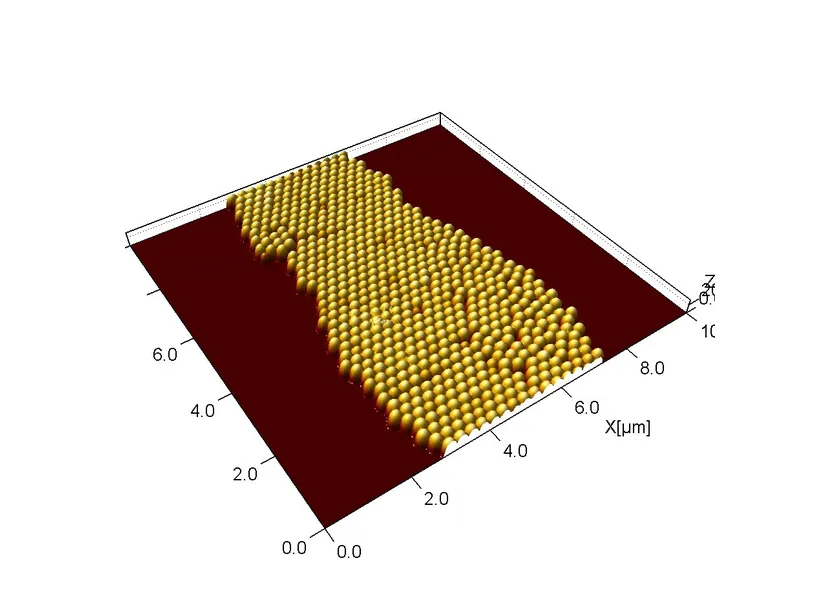
ISO/IEC 17025 particle size standards 5
Size standards from the NanoStandards and MicroStandards lines whose mean diameter is certified by an independent ISO/IEC 17025 accredited metrology institute, on material from the original lots. Beyond NIST traceability, usually obtained by in-house measurements against SRMs, here the measurement is performed under accreditation: atomic force microscopy (AFM) from 0.1 to 5 µm and laser scanning confocal microscopy (LSCM) from 10 to 30 µm. The certificate is ISO/IEC 17025 compliant and meets the requirements for instrument calibration in an accredited laboratory. 5 mL vials; each code states the certified mean diameter of the lot.
Series technical data
| Material | Monodisperse polymer (polystyrene) microspheres from the original NanoStandards and MicroStandards lots |
|---|---|
| Form | Aqueous suspension |
| Nominal diameters | 100, 300 and 500 nm; 1 and 5 µm |
| Certified mean diameter | 89.7 nm; 331.4 nm; 512.6 nm; 1.046 µm; 4.906 µm (by code) |
| Certification | Independent metrology institute accredited to ISO/IEC 17025 |
| Accredited methods | Atomic force microscopy (AFM) from 0.1 to 5 µm; laser scanning confocal microscopy (LSCM) from 10 to 30 µm |
| Traceability | SI, including NIST |
| Certificate | ISO/IEC 17025 compliant |
| Pack | 5 mL vial |
| Use | Instrument calibration under ISO/IEC 17025 |
ISO/IEC 17025 particle size standards100 nmNanoStandards™/MicroStandards™ ISO 17025 Particle Size Standard 100 nm (mean 89.7 nm)Cat. No. 13010-05Pack size 5 mLPrice ISO/IEC 17025 particle size standards300 nmNanoStandards™/MicroStandards™ ISO 17025 Particle Size Standard 300 nm (mean 331.4 nm)Cat. No. 13030-05Pack size 5 mLPrice ISO/IEC 17025 particle size standards500 nmNanoStandards™/MicroStandards™ ISO 17025 Particle Size Standard 500 nm (mean 512.6 nm)Cat. No. 13050-05Pack size 5 mLPrice ISO/IEC 17025 particle size standards1 µmNanoStandards™/MicroStandards™ ISO 17025 Particle Size Standard 1 µm (mean 1.046 µm)Cat. No. 13100-05Pack size 5 mLPrice ISO/IEC 17025 particle size standards5 µmNanoStandards™/MicroStandards™ ISO 17025 Particle Size Standard 5 µm (mean 4.906 µm)Cat. No. 13500-05Pack size 5 mLPrice 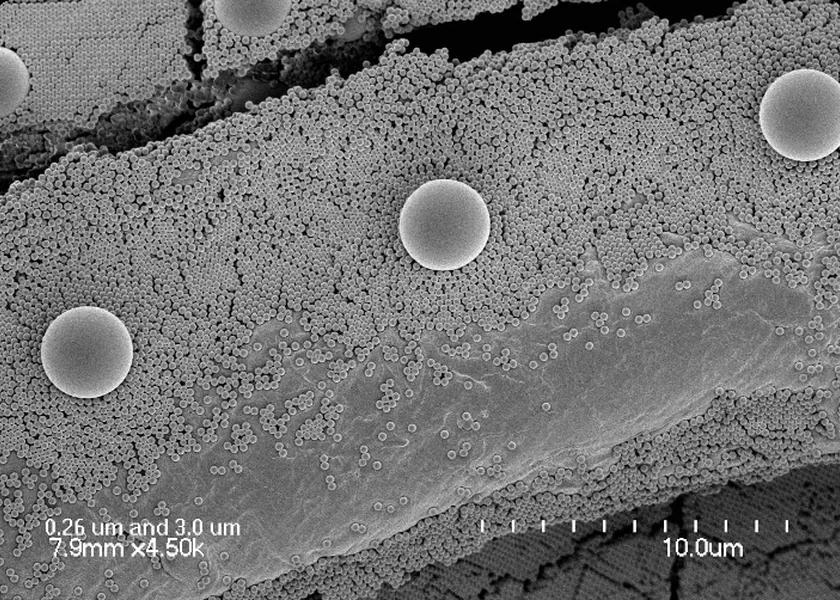
Multi-size standards 1
Mixture of five monodisperse polymer microsphere populations, from 0.06 to 2 µm, in a single 1% aqueous suspension. It tests the resolution of particle sizers, for example laser diffraction instruments, in advanced operational qualification and size calibration, and helps determine the cut-off of filter media. The medium is formulated to prevent agglomerates and to remain stable over time. Certification covers d10, d50 and d90 or full traceability of the individual diameters.
Series technical data
| Composition | 5 monodisperse populations of polymer (polystyrene) microspheres |
|---|---|
| Diameter range | 0.06-2 µm |
| Form | Aqueous suspension formulated against agglomerates, long-term stable |
| Concentration (solids) | 1% |
| Pack | 3 mL |
| Certification | d10, d50 and d90 values, or full traceability of the individual diameters |
| On request | Other diameter mixtures and distributions |
Multi-size standards0.06-2 µmPentamodal-Size Standard (0.06-2 µm, 5 monodisperse populations) 1% suspensionCat. No. 15001-03Pack size 3 mLPrice 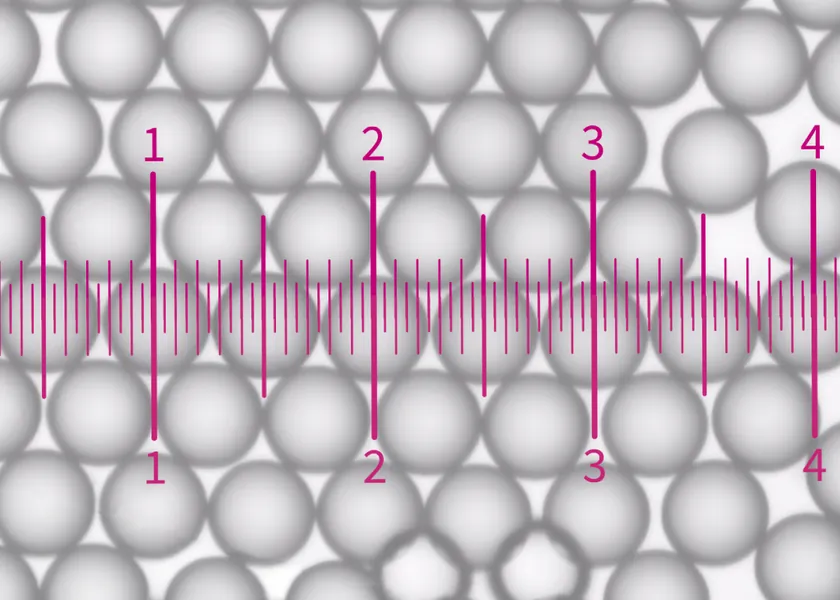
Powder size standards 34
Cross-linked polystyrene microspheres as dry powder, for size and count instruments that can only be calibrated with dry particles. The certified mean diameter is traceable to SI and NIST through standards certified by ISO 17025 accredited metrology institutes and NIST reference materials, with a calibration uncertainty below 2.5%: the level required by ISO 21501-4 for airborne particle counters. Density 1.05 g/cm³, refractive index 1.59 at 589 nm, diameters from 3 to 500 µm in 1 g bottles. They are not meant to be redispersed in water.
Series technical data
| Material | Cross-linked polystyrene |
|---|---|
| Form | Dry powder (not well suited for redispersion in water) |
| Density | 1.05 g/cm³ |
| Refractive index | 1.59 at 589 nm |
| Diameters | 3-500 µm (34 diameters) |
| Quantity | 1 g |
| Particles per gram | About 6.7 × 10¹⁰ (3 µm) - 1.4 × 10⁴ (500 µm) |
| Traceability | SI and NIST, through standards certified by ISO 17025 accredited metrology institutes and NIST SRMs |
| Calibration uncertainty | Below 2.5%, as required by ISO 21501-4 |
| Lot certificate | Certified mean diameter |
| Storage | Room temperature (4-30 °C), away from direct sunlight |
Powder size standards3 µmPowder MicroStandards™ Particle Size Standard 3 µmCat. No. 81030-01Pack size 1 gPrice Powder size standards4 µmPowder MicroStandards™ Particle Size Standard 4 µmCat. No. 81040-01Pack size 1 gPrice Powder size standards5 µmPowder MicroStandards™ Particle Size Standard 5 µmCat. No. 81050-01Pack size 1 gPrice Powder size standards6 µmPowder MicroStandards™ Particle Size Standard 6 µmCat. No. 81060-01Pack size 1 gPrice Powder size standards8 µmPowder MicroStandards™ Particle Size Standard 8 µmCat. No. 81080-01Pack size 1 gPrice Powder size standards10 µmPowder MicroStandards™ Particle Size Standard 10 µmCat. No. 81100-01Pack size 1 gPrice Powder size standards14 µmPowder MicroStandards™ Particle Size Standard 14 µmCat. No. 81140-01Pack size 1 gPrice Powder size standards15 µmPowder MicroStandards™ Particle Size Standard 15 µmCat. No. 81150-01Pack size 1 gPrice Powder size standards20 µmPowder MicroStandards™ Particle Size Standard 20 µmCat. No. 81200-01Pack size 1 gPrice Powder size standards25 µmPowder MicroStandards™ Particle Size Standard 25 µmCat. No. 81250-01Pack size 1 gPrice Powder size standards30 µmPowder MicroStandards™ Particle Size Standard 30 µmCat. No. 81300-01Pack size 1 gPrice Powder size standards40 µmPowder MicroStandards™ Particle Size Standard 40 µmCat. No. 81400-01Pack size 1 gPrice Powder size standards50 µmPowder MicroStandards™ Particle Size Standard 50 µmCat. No. 81500-01Pack size 1 gPrice Powder size standards60 µmPowder MicroStandards™ Particle Size Standard 60 µmCat. No. 81600-01Pack size 1 gPrice Powder size standards70 µmPowder MicroStandards™ Particle Size Standard 70 µmCat. No. 81700-01Pack size 1 gPrice Powder size standards80 µmPowder MicroStandards™ Particle Size Standard 80 µmCat. No. 81800-01Pack size 1 gPrice Powder size standards90 µmPowder MicroStandards™ Particle Size Standard 90 µmCat. No. 81900-01Pack size 1 gPrice Powder size standards100 µmPowder MicroStandards™ Particle Size Standard 100 µmCat. No. 82010-01Pack size 1 gPrice Powder size standards110 µmPowder MicroStandards™ Particle Size Standard 110 µmCat. No. 82011-01Pack size 1 gPrice Powder size standards120 µmPowder MicroStandards™ Particle Size Standard 120 µmCat. No. 82012-01Pack size 1 gPrice Powder size standards130 µmPowder MicroStandards™ Particle Size Standard 130 µmCat. No. 82013-01Pack size 1 gPrice Powder size standards140 µmPowder MicroStandards™ Particle Size Standard 140 µmCat. No. 82014-01Pack size 1 gPrice Powder size standards150 µmPowder MicroStandards™ Particle Size Standard 150 µmCat. No. 82015-01Pack size 1 gPrice Powder size standards160 µmPowder MicroStandards™ Particle Size Standard 160 µmCat. No. 82016-01Pack size 1 gPrice Powder size standards170 µmPowder MicroStandards™ Particle Size Standard 170 µmCat. No. 82017-01Pack size 1 gPrice Powder size standards180 µmPowder MicroStandards™ Particle Size Standard 180 µmCat. No. 82018-01Pack size 1 gPrice Powder size standards190 µmPowder MicroStandards™ Particle Size Standard 190 µmCat. No. 82019-01Pack size 1 gPrice Powder size standards200 µmPowder MicroStandards™ Particle Size Standard 200 µmCat. No. 82020-01Pack size 1 gPrice Powder size standards250 µmPowder MicroStandards™ Particle Size Standard 250 µmCat. No. 82025-01Pack size 1 gPrice Powder size standards300 µmPowder MicroStandards™ Particle Size Standard 300 µmCat. No. 82030-01Pack size 1 gPrice Powder size standards350 µmPowder MicroStandards™ Particle Size Standard 350 µmCat. No. 82035-01Pack size 1 gPrice Powder size standards400 µmPowder MicroStandards™ Particle Size Standard 400 µmCat. No. 82040-01Pack size 1 gPrice Powder size standards450 µmPowder MicroStandards™ Particle Size Standard 450 µmCat. No. 82045-01Pack size 1 gPrice Powder size standards500 µmPowder MicroStandards™ Particle Size Standard 500 µmCat. No. 82050-01Pack size 1 gPrice Glass size standards 3
Glass microspheres as dry powder, used as size standards for powder particle sizing and for optical microscopy calibration, traceable to NIST and SI. Nominal diameters 50, 100 and 200 µm, in 1 g packs. Glass type, size distribution and certificate content are confirmed with the quote.
Series technical data
| Material | Glass microspheres |
|---|---|
| Form | Dry powder |
| Diameters | 50, 100 and 200 µm |
| Quantity | 1 g |
| Traceability | NIST and SI |
Glass size standards50 µmGlass Size Standard 50 µmCat. No. 41500-01Pack size 1 gPrice Glass size standards100 µmGlass Size Standard 100 µmCat. No. 42010-01Pack size 1 gPrice Glass size standards200 µmGlass Size Standard 200 µmCat. No. 42020-01Pack size 1 gPrice 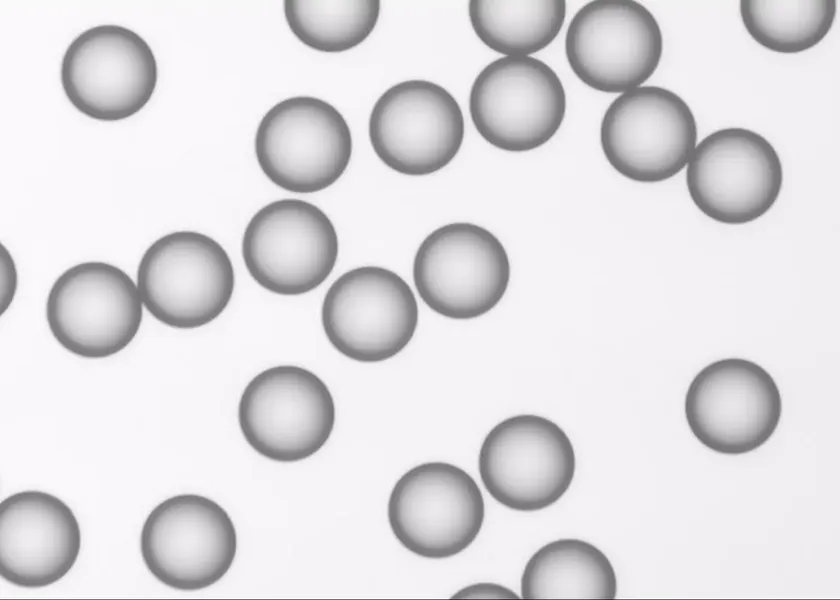
Size and count controls 30
Size standard and count control in the same bottle: monodisperse polystyrene microspheres with diameter traceable to SI, including NIST, and number concentration checked on every lot, with a count uncertainty of ±10%. The low-residue aqueous medium keeps background interference to a minimum, and concentrations are ready for direct use or simple dilution in liquid laser particle counters. Refractive index 1.59 at 589 nm and density 1.05 g/cm³, so settling during the test is slow. 20 mL dropper bottles with long shelf life at room temperature.
Series technical data
| Material | Monodisperse polystyrene microspheres |
|---|---|
| Refractive index | 1.59 at 589 nm |
| Density | 1.05 g/cm³ (slow settling) |
| Form | Low-residue aqueous suspension, formulated to reduce background |
| Diameters | 0.1-100 µm |
| Nominal concentration | From 10⁹ particles/mL (0.4 µm) to 10⁴ particles/mL (90-100 µm), referred to a threshold channel |
| Count uncertainty | ±10% |
| Diameter traceability | SI, including NIST |
| Calibration | Electron or optical microscopy, ESZ, SPOS, laser diffraction and ADC, with reference materials from ISO/IEC 17025 accredited institutes and NIST SRMs |
| Pack | 20 mL dropper bottle |
| Storage | Room temperature (4-30 °C) |
Size and count controls0.1 µmSize Standard and Count Control 0.1 µmCat. No. 21100-20Pack size 20 mLPrice Size and count controls0.2 µmSize Standard and Count Control 0.2 µmCat. No. 21200-20Pack size 20 mLPrice Size and count controls0.3 µmSize Standard and Count Control 0.3 µmCat. No. 21300-20Pack size 20 mLPrice Size and count controls0.4 µmSize Standard and Count Control 0.4 µmCat. No. 21400-20Pack size 20 mLPrice Size and count controls0.5 µmSize Standard and Count Control 0.5 µmCat. No. 21500-20Pack size 20 mLPrice Size and count controls0.6 µmSize Standard and Count Control 0.6 µmCat. No. 21600-20Pack size 20 mLPrice Size and count controls0.7 µmSize Standard and Count Control 0.7 µmCat. No. 21700-20Pack size 20 mLPrice Size and count controls0.8 µmSize Standard and Count Control 0.8 µmCat. No. 21800-20Pack size 20 mLPrice Size and count controls0.9 µmSize Standard and Count Control 0.9 µmCat. No. 21900-20Pack size 20 mLPrice Size and count controls1 µmSize Standard and Count Control 1 µmCat. No. 22010-20Pack size 20 mLPrice Size and count controls2 µmSize Standard and Count Control 2 µmCat. No. 22020-20Pack size 20 mLPrice Size and count controls3 µmSize Standard and Count Control 3 µmCat. No. 22030-20Pack size 20 mLPrice Size and count controls4 µmSize Standard and Count Control 4 µmCat. No. 22040-20Pack size 20 mLPrice Size and count controls5 µmSize Standard and Count Control 5 µmCat. No. 22050-20Pack size 20 mLPrice Size and count controls6 µmSize Standard and Count Control 6 µmCat. No. 22060-20Pack size 20 mLPrice Size and count controls7 µmSize Standard and Count Control 7 µmCat. No. 22070-20Pack size 20 mLPrice Size and count controls8 µmSize Standard and Count Control 8 µmCat. No. 22080-20Pack size 20 mLPrice Size and count controls9 µmSize Standard and Count Control 9 µmCat. No. 22090-20Pack size 20 mLPrice Size and count controls10 µmSize Standard and Count Control 10 µmCat. No. 22100-20Pack size 20 mLPrice Size and count controls15 µmSize Standard and Count Control 15 µmCat. No. 22150-20Pack size 20 mLPrice Size and count controls20 µmSize Standard and Count Control 20 µmCat. No. 22200-20Pack size 20 mLPrice Size and count controls25 µmSize Standard and Count Control 25 µmCat. No. 22250-20Pack size 20 mLPrice Size and count controls30 µmSize Standard and Count Control 30 µmCat. No. 22300-20Pack size 20 mLPrice Size and count controls40 µmSize Standard and Count Control 40 µmCat. No. 22400-20Pack size 20 mLPrice Size and count controls50 µmSize Standard and Count Control 50 µmCat. No. 22500-20Pack size 20 mLPrice Size and count controls60 µmSize Standard and Count Control 60 µmCat. No. 22600-20Pack size 20 mLPrice Size and count controls70 µmSize Standard and Count Control 70 µmCat. No. 22700-20Pack size 20 mLPrice Size and count controls80 µmSize Standard and Count Control 80 µmCat. No. 22800-20Pack size 20 mLPrice Size and count controls90 µmSize Standard and Count Control 90 µmCat. No. 22900-20Pack size 20 mLPrice Size and count controls100 µmSize Standard and Count Control 100 µmCat. No. 23010-20Pack size 20 mLPrice 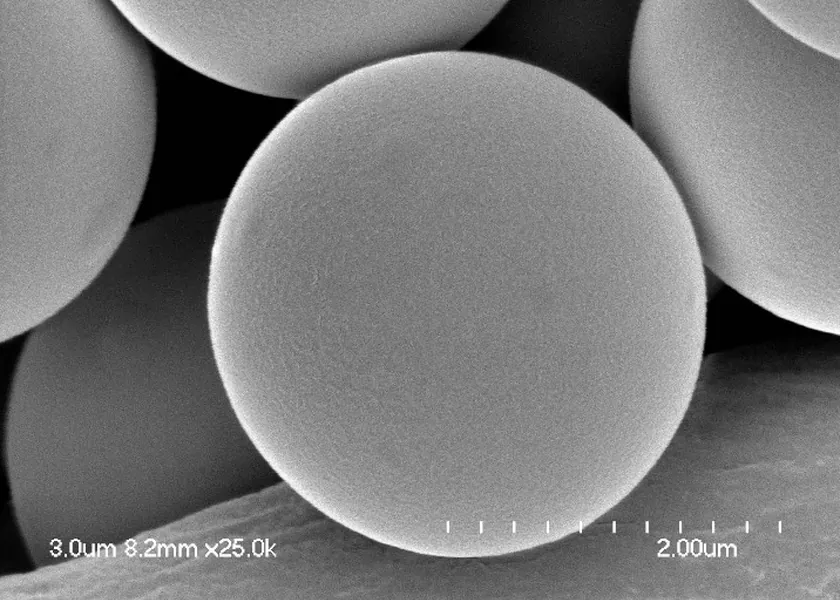
Pharmacopoeial count controls 8
PharmaCount series: polystyrene microsphere suspensions with a defined number of particles, to keep liquid particle counters under control in pharmaceutical quality control laboratories working to the US, European, Japanese and Korean pharmacopoeias. They reproduce the characteristics of the standards called for by the methods (USP <788> and <1788.1>, USP <729>, JP and KP) and are meant for routine checks in GMP environments, without replacing the official pharmacopoeial standards. Diameters traceable to SI, including NIST; every pack comes with a certificate of traceability, and the bottles hold a magnetic stir bar for uniform dispersion during sampling.
Series technical data
| Material | Monodisperse polystyrene microspheres |
|---|---|
| Form | Ready-to-use aqueous suspension |
| Traceability | Diameters traceable to SI, including NIST |
| Certificate | Certificate of traceability with every pack, suitable for GMP records |
| Mixing | Magnetic stir bar in every bottle |
| Pharmacopoeias | USP <788> and <1788.1> (light obscuration), USP <729> (lipid injectable emulsions), JP 6.07 and KP 1613 (insoluble particulate matter in injections) |
| Formats | 6 x 25 mL, 2 x 50 mL, 25 mL kits with blank |
| Use | Intermediate instrument control; does not replace official pharmacopoeial standards |
Pharmacopoeial count controlsPharmaCount™ Blank Low-particle-content DI Water (6 x 25 mL)Cat. No. 20000-25Pack size 6 x 25 mLPrice Pharmacopoeial count controls10 µmPharmaCount™ JPKP Size Standard and Count Control JP XVII 6.07 and KP X 1613 (2 x 50 mL)Cat. No. 20010-50Pack size 2 x 50 mLPrice Pharmacopoeial count controls15 µmPharmaCount™ US Size Standard and Count Control <USP788> (6 x 25 mL)Cat. No. 20015-25Pack size 6 x 25 mLPrice Pharmacopoeial count controlsPharmaCount™ AsFound Size Standard and Count Control <USP788> ≥10 µm: 3,000 Part./mL (2 x 50 mL)Cat. No. 20015-50Pack size 2 x 50 mLPrice Pharmacopoeial count controls5, 10 µmPharmaCount™ BiCal Size Standard and Count Control <USP729> (6 x 25 mL)Cat. No. 20510-25Pack size 6 x 25 mLPrice Pharmacopoeial count controls0.8, 2, 5 µmPharmaCount™ TriCal Size Standard and Count Control for auto-diluters (6 x 25 mL)Cat. No. 20825-25Pack size 6 x 25 mLPrice Pharmacopoeial count controls12.2, 20 µmPharmaCount™ 1510 Count Control <USP788>, kit of suspension, blank and certificate (25 mL each)Cat. No. Ph1510-25Pack size 25 mL eachPrice Pharmacopoeial count controls12.2, 20 µmPharmaCount™ 1510 Count Control <USP788>, box of 3 kits (25 mL each)Cat. No. Ph1510a25Pack size 3 x 25 mLPrice Count control sets 11
PharmaCount 3M set: six 25 mL bottles of the same ready-to-use monodisperse microsphere suspension at 3,000 particles/mL, to set or check channel thresholds and count precision of liquid optical particle counters, with no dilution. The microspheres are polystyrene cross-linked with divinylbenzene (refractive index 1.59 at 589 nm, density 1.05 g/cm³), in an aqueous medium with dispersing agents that prevent clumping and adhesion to flow surfaces. Certified diameters are traceable to SI, including NIST, and every bottle has its own magnetic stir bar for direct sampling.
Series technical data
| Content | 6 bottles of suspension, 25 mL each |
|---|---|
| Nominal concentration | 3,000 particles/mL |
| Material | Polystyrene cross-linked with divinylbenzene (DVB) |
| Refractive index | 1.59 at 589 nm |
| Density | 1.05 g/cm³ |
| Medium | Aqueous with dispersing agents against clumping and adhesion to surfaces |
| Diameters | 2-100 µm (11 diameters) |
| Traceability | Certified diameters traceable to SI, including NIST |
| Accessories | Magnetic stir bar in every bottle |
| Use | Ready to use, no dilution |
Count control sets2 µmPharmaCount™ 3M Series Count Control Set 2 µm (6 x 25 mL)Cat. No. 3M002-25Pack size 6 x 25 mLPrice Count control sets5 µmPharmaCount™ 3M Series Count Control Set 5 µm (6 x 25 mL)Cat. No. 3M005-25Pack size 6 x 25 mLPrice Count control sets10 µmPharmaCount™ 3M Series Count Control Set 10 µm (6 x 25 mL)Cat. No. 3M010-25Pack size 6 x 25 mLPrice Count control sets15 µmPharmaCount™ 3M Series Count Control Set 15 µm (6 x 25 mL)Cat. No. 3M015-25Pack size 6 x 25 mLPrice Count control sets20 µmPharmaCount™ 3M Series Count Control Set 20 µm (6 x 25 mL)Cat. No. 3M020-25Pack size 6 x 25 mLPrice Count control sets25 µmPharmaCount™ 3M Series Count Control Set 25 µm (6 x 25 mL)Cat. No. 3M025-25Pack size 6 x 25 mLPrice Count control sets30 µmPharmaCount™ 3M Series Count Control Set 30 µm (6 x 25 mL)Cat. No. 3M030-25Pack size 6 x 25 mLPrice Count control sets40 µmPharmaCount™ 3M Series Count Control Set 40 µm (6 x 25 mL)Cat. No. 3M040-25Pack size 6 x 25 mLPrice Count control sets50 µmPharmaCount™ 3M Series Count Control Set 50 µm (6 x 25 mL)Cat. No. 3M050-25Pack size 6 x 25 mLPrice Count control sets70 µmPharmaCount™ 3M Series Count Control Set 70 µm (6 x 25 mL)Cat. No. 3M070-25Pack size 6 x 25 mLPrice Count control sets100 µmPharmaCount™ 3M Series Count Control Set 100 µm (6 x 25 mL)Cat. No. 3M100-25Pack size 6 x 25 mLPrice Count control sets, PC series 11
PC series sets with the same composition and use as PharmaCount 3M: ready-to-use monodisperse microsphere suspensions at 3,000 particles/mL to check channel thresholds and count precision of liquid optical counters. Only the packaging differs: three bottles of suspension and three of blank, 25 mL each, so each test has its own background control. Polystyrene cross-linked with divinylbenzene, diameters traceable to SI and NIST.
Series technical data
| Content | 3 bottles of suspension and 3 bottles of blank, 25 mL each |
|---|---|
| Nominal concentration | 3,000 particles/mL |
| Material | Polystyrene cross-linked with divinylbenzene (DVB) |
| Refractive index | 1.59 at 589 nm |
| Density | 1.05 g/cm³ |
| Diameters | 2-100 µm (11 diameters) |
| Traceability | Certified diameters traceable to SI, including NIST |
| Equivalence | Same composition, properties and use as the PharmaCount 3M sets |
Count control sets, PC series2 µmPC Series Count Control Set 2 µm (3 x suspension + 3 x blank, 25 mL each)Cat. No. PC0203a25Pack size 3 x 25 mLPrice Count control sets, PC series5 µmPC Series Count Control Set 5 µm (3 x suspension + 3 x blank, 25 mL each)Cat. No. PC0503a25Pack size 3 x 25 mLPrice Count control sets, PC series10 µmPC Series Count Control Set 10 µm (3 x suspension + 3 x blank, 25 mL each)Cat. No. PC1003a25Pack size 3 x 25 mLPrice Count control sets, PC series15 µmPC Series Count Control Set 15 µm (3 x suspension + 3 x blank, 25 mL each)Cat. No. PC1503a25Pack size 3 x 25 mLPrice Count control sets, PC series20 µmPC Series Count Control Set 20 µm (3 x suspension + 3 x blank, 25 mL each)Cat. No. PC2003a25Pack size 3 x 25 mLPrice Count control sets, PC series25 µmPC Series Count Control Set 25 µm (3 x suspension + 3 x blank, 25 mL each)Cat. No. PC2503a25Pack size 3 x 25 mLPrice Count control sets, PC series30 µmPC Series Count Control Set 30 µm (3 x suspension + 3 x blank, 25 mL each)Cat. No. PC3003a25Pack size 3 x 25 mLPrice Count control sets, PC series40 µmPC Series Count Control Set 40 µm (3 x suspension + 3 x blank, 25 mL each)Cat. No. PC4003a25Pack size 3 x 25 mLPrice Count control sets, PC series50 µmPC Series Count Control Set 50 µm (3 x suspension + 3 x blank, 25 mL each)Cat. No. PC5003a25Pack size 3 x 25 mLPrice Count control sets, PC series70 µmPC Series Count Control Set 70 µm (3 x suspension + 3 x blank, 25 mL each)Cat. No. PC7003a25Pack size 3 x 25 mLPrice Count control sets, PC series100 µmPC Series Count Control Set 100 µm (3 x suspension + 3 x blank, 25 mL each)Cat. No. PC10003a25Pack size 3 x 25 mLPrice 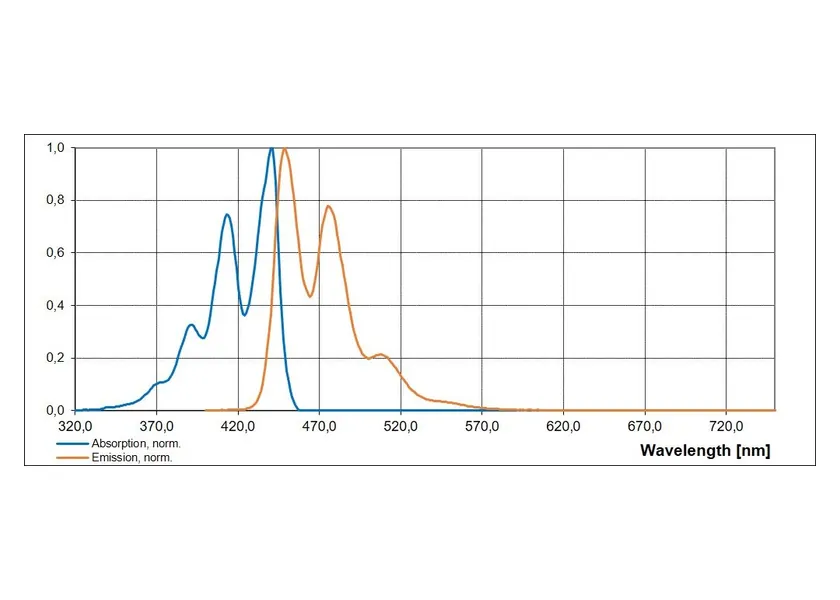
Fluorescent microspheres 54
Polystyrene microspheres with the fluorescent dye incorporated during polymerisation, so no dye leakage, in three colours: blue, green and red. Fluorescence is bright and very uniform from particle to particle, and it does not degrade in water or when the microspheres are dispersed in air. They are detected with flow cytometers, epifluorescence and confocal microscopes, fluorescence spectrophotometers and even with a black light, directly in the sample or collected on a membrane filter. 1% aqueous suspension in 3 or 50 mL bottles, or 1 g of dry powder for diameters from 5 to 20 µm.
Series technical data
| Material | Polystyrene with fluorescent dye incorporated in the matrix during polymerisation |
|---|---|
| Colours | Blue, green, red |
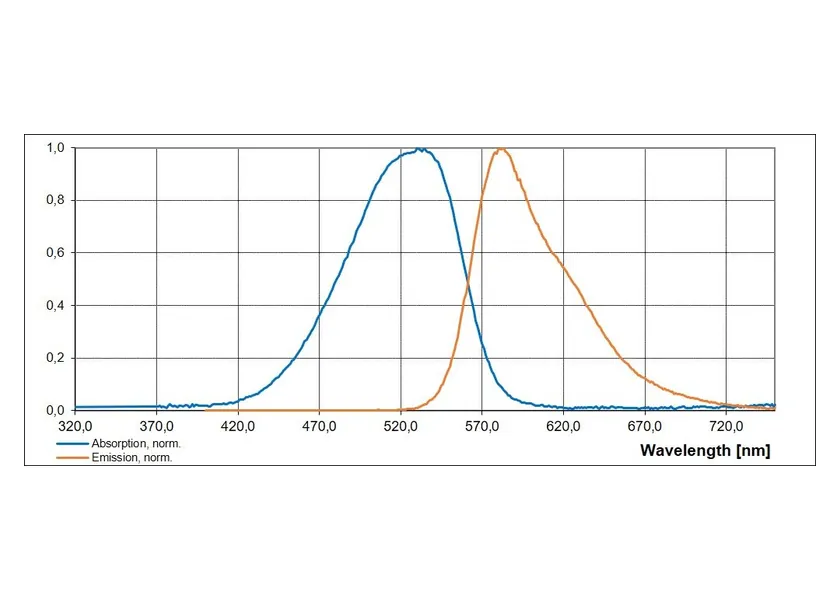
| Blue: excitation / emission | 380-450 nm / 440-520 nm |
| Green: excitation / emission | 400-490 nm / 470-560 nm |
| Red: excitation / emission | 450-570 nm / 550-660 nm |
| Diameters | 0.1; 0.5; 1; 5; 10; 15; 20 µm |
| Form | 1% aqueous suspension (solids) or dry powder |
| Packs | Suspension 3 mL or 50 mL; powder 1 g (from 5 to 20 µm) |
| Fluorescence | High intensity, low particle-to-particle variation, no dye leakage |
| Storage | Room temperature |
Fluorescent microspheres0.1 µmBlue Fluorescent Polymer Microspheres 0.1 µm 1% suspensionCat. No. 50100B-03Pack size 3 mLPrice Fluorescent microspheres0.1 µmBlue Fluorescent Polymer Microspheres 0.1 µm 1% suspensionCat. No. 50100B-50Pack size 50 mLPrice 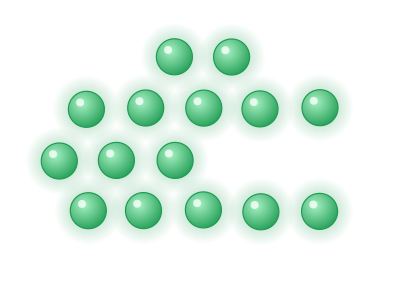 Fluorescent microspheres0.1 µmGreen Fluorescent Polymer Microspheres 0.1 µm 1% suspensionCat. No. 50100G-03Pack size 3 mLPrice Fluorescent microspheres0.1 µmGreen Fluorescent Polymer Microspheres 0.1 µm 1% suspensionCat. No. 50100G-50Pack size 50 mLPrice
 Fluorescent microspheres0.1 µmRed Fluorescent Polymer Microspheres 0.1 µm 1% suspensionCat. No. 50100R-03Pack size 3 mLPrice Fluorescent microspheres0.1 µmRed Fluorescent Polymer Microspheres 0.1 µm 1% suspensionCat. No. 50100R-50Pack size 50 mLPrice Fluorescent microspheres0.5 µmBlue Fluorescent Polymer Microspheres 0.5 µm 1% suspensionCat. No. 50500B-03Pack size 3 mLPrice Fluorescent microspheres0.5 µmBlue Fluorescent Polymer Microspheres 0.5 µm 1% suspensionCat. No. 50500B-50Pack size 50 mLPrice Fluorescent microspheres0.5 µmGreen Fluorescent Polymer Microspheres 0.5 µm 1% suspensionCat. No. 50500G-03Pack size 3 mLPrice Fluorescent microspheres0.5 µmGreen Fluorescent Polymer Microspheres 0.5 µm 1% suspensionCat. No. 50500G-50Pack size 50 mLPrice Fluorescent microspheres0.5 µmRed Fluorescent Polymer Microspheres 0.5 µm 1% suspensionCat. No. 50500R-03Pack size 3 mLPrice Fluorescent microspheres0.5 µmRed Fluorescent Polymer Microspheres 0.5 µm 1% suspensionCat. No. 50500R-50Pack size 50 mLPrice Fluorescent microspheres1 µmBlue Fluorescent Polymer Microspheres 1 µm 1% suspensionCat. No. 51010B-03Pack size 3 mLPrice Fluorescent microspheres1 µmBlue Fluorescent Polymer Microspheres 1 µm 1% suspensionCat. No. 51010B-50Pack size 50 mLPrice Fluorescent microspheres1 µmGreen Fluorescent Polymer Microspheres 1 µm 1% suspensionCat. No. 51010G-03Pack size 3 mLPrice Fluorescent microspheres1 µmGreen Fluorescent Polymer Microspheres 1 µm 1% suspensionCat. No. 51010G-50Pack size 50 mLPrice Fluorescent microspheres1 µmRed Fluorescent Polymer Microspheres 1 µm 1% suspensionCat. No. 51010R-03Pack size 3 mLPrice Fluorescent microspheres1 µmRed Fluorescent Polymer Microspheres 1 µm 1% suspensionCat. No. 51010R-50Pack size 50 mLPrice Fluorescent microspheres5 µmBlue Fluorescent Polymer Microspheres 5 µm 1% suspensionCat. No. 51050B-01Pack size 1 gPrice Fluorescent microspheres5 µmBlue Fluorescent Polymer Microspheres 5 µm 1% suspensionCat. No. 51050B-03Pack size 3 mLPrice Fluorescent microspheres5 µmBlue Fluorescent Polymer Microspheres 5 µm 1% suspensionCat. No. 51050B-50Pack size 50 mLPrice Fluorescent microspheres5 µmGreen Fluorescent Polymer Microspheres 5 µm 1% suspensionCat. No. 51050G-01Pack size 1 gPrice Fluorescent microspheres5 µmGreen Fluorescent Polymer Microspheres 5 µm 1% suspensionCat. No. 51050G-03Pack size 3 mLPrice Fluorescent microspheres5 µmGreen Fluorescent Polymer Microspheres 5 µm 1% suspensionCat. No. 51050G-50Pack size 50 mLPrice Fluorescent microspheres5 µmRed Fluorescent Polymer Microspheres 5 µm 1% suspensionCat. No. 51050R-01Pack size 1 gPrice Fluorescent microspheres5 µmRed Fluorescent Polymer Microspheres 5 µm 1% suspensionCat. No. 51050R-03Pack size 3 mLPrice Fluorescent microspheres5 µmRed Fluorescent Polymer Microspheres 5 µm 1% suspensionCat. No. 51050R-50Pack size 50 mLPrice Fluorescent microspheres10 µmBlue Fluorescent Polymer Microspheres 10 µm 1% suspensionCat. No. 51100B-01Pack size 1 gPrice Fluorescent microspheres10 µmBlue Fluorescent Polymer Microspheres 10 µm 1% suspensionCat. No. 51100B-03Pack size 3 mLPrice Fluorescent microspheres10 µmBlue Fluorescent Polymer Microspheres 10 µm 1% suspensionCat. No. 51100B-50Pack size 50 mLPrice Fluorescent microspheres10 µmGreen Fluorescent Polymer Microspheres 10 µm 1% suspensionCat. No. 51100G-01Pack size 1 gPrice Fluorescent microspheres10 µmGreen Fluorescent Polymer Microspheres 10 µm 1% suspensionCat. No. 51100G-03Pack size 3 mLPrice Fluorescent microspheres10 µmGreen Fluorescent Polymer Microspheres 10 µm 1% suspensionCat. No. 51100G-50Pack size 50 mLPrice Fluorescent microspheres10 µmRed Fluorescent Polymer Microspheres 10 µm 1% suspensionCat. No. 51100R-01Pack size 1 gPrice Fluorescent microspheres10 µmRed Fluorescent Polymer Microspheres 10 µm 1% suspensionCat. No. 51100R-03Pack size 3 mLPrice Fluorescent microspheres10 µmRed Fluorescent Polymer Microspheres 10 µm 1% suspensionCat. No. 51100R-50Pack size 50 mLPrice Fluorescent microspheres15 µmBlue Fluorescent Polymer Microspheres 15 µm 1% suspensionCat. No. 51150B-01Pack size 1 gPrice Fluorescent microspheres15 µmBlue Fluorescent Polymer Microspheres 15 µm 1% suspensionCat. No. 51150B-03Pack size 3 mLPrice Fluorescent microspheres15 µmBlue Fluorescent Polymer Microspheres 15 µm 1% suspensionCat. No. 51150B-50Pack size 50 mLPrice Fluorescent microspheres15 µmGreen Fluorescent Polymer Microspheres 15 µm 1% suspensionCat. No. 51150G-01Pack size 1 gPrice Fluorescent microspheres15 µmGreen Fluorescent Polymer Microspheres 15 µm 1% suspensionCat. No. 51150G-03Pack size 3 mLPrice Fluorescent microspheres15 µmGreen Fluorescent Polymer Microspheres 15 µm 1% suspensionCat. No. 51150G-50Pack size 50 mLPrice Fluorescent microspheres15 µmRed Fluorescent Polymer Microspheres 15 µm 1% suspensionCat. No. 51150R-01Pack size 1 gPrice Fluorescent microspheres15 µmRed Fluorescent Polymer Microspheres 15 µm 1% suspensionCat. No. 51150R-03Pack size 3 mLPrice Fluorescent microspheres15 µmRed Fluorescent Polymer Microspheres 15 µm 1% suspensionCat. No. 51150R-50Pack size 50 mLPrice Fluorescent microspheres20 µmBlue Fluorescent Polymer Microspheres 20 µm 1% suspensionCat. No. 51200B-01Pack size 1 gPrice Fluorescent microspheres20 µmBlue Fluorescent Polymer Microspheres 20 µm 1% suspensionCat. No. 51200B-03Pack size 3 mLPrice Fluorescent microspheres20 µmBlue Fluorescent Polymer Microspheres 20 µm 1% suspensionCat. No. 51200B-50Pack size 50 mLPrice Fluorescent microspheres20 µmGreen Fluorescent Polymer Microspheres 20 µm 1% suspensionCat. No. 51200G-01Pack size 1 gPrice Fluorescent microspheres20 µmGreen Fluorescent Polymer Microspheres 20 µm 1% suspensionCat. No. 51200G-03Pack size 3 mLPrice Fluorescent microspheres20 µmGreen Fluorescent Polymer Microspheres 20 µm 1% suspensionCat. No. 51200G-50Pack size 50 mLPrice Fluorescent microspheres20 µmRed Fluorescent Polymer Microspheres 20 µm 1% suspensionCat. No. 51200R-01Pack size 1 gPrice Fluorescent microspheres20 µmRed Fluorescent Polymer Microspheres 20 µm 1% suspensionCat. No. 51200R-03Pack size 3 mLPrice Fluorescent microspheres20 µmRed Fluorescent Polymer Microspheres 20 µm 1% suspensionCat. No. 51200R-50Pack size 50 mLPrice
Zeta potential controls 3
Ready-to-use zeta potential controls: 200 nm surface-modified polystyrene particles, negatively (-60 mV) or positively (+60 mV) charged, to verify instruments that measure electrophoretic mobility or streaming potential. The medium contains no charged surfactants and is buffered against CO₂ uptake, so background signal is minimal and the chemical environment stays stable. Concentration suits the most common measurement set-ups, with a defined electrophoretic mobility value. Single-use Luer-lock syringes of 3 mL (6 per pack) or 10 mL (10 per pack), shelf life 12-18 months from manufacture at room temperature.
Series technical data
| Material | Surface-modified polystyrene particles |
|---|---|
| Nominal diameter | 200 nm |
| Nominal zeta potential | -60 mV (negatively charged) or +60 mV (positively charged) |
| pH | 8.0 ± 0.5 (negative); 5.0 ± 0.5 (positive) |
| Solids | 0.02% |
| Density | 1.05 g/cm³ |
| Refractive index | 1.59 at 589 nm |
| Medium | Free of charged surfactants, buffered against CO₂ uptake |
| Pack | Ready-to-use single-use syringes with Luer-lock fitting: 6 x 3 mL or 10 x 10 mL |
| Methods | Electrophoretic mobility and streaming potential |
| Shelf life | 12-18 months from the date of manufacture |
| Storage | Room temperature |
Zeta potential controls200 nmZeta Potential Control Negatively Charged -60 mV (6 x 3 mL syringes)Cat. No. 70306CPack size 6 x 3 mLPrice Zeta potential controls200 nmZeta Potential Control Positively Charged +60 mV (6 x 3 mL syringes)Cat. No. 70306NPack size 6 x 3 mLPrice Zeta potential controls200 nmZeta Potential Control Negatively Charged -60 mV (10 x 10 mL syringes)Cat. No. 71010CPack size 10 x 10 mLPrice 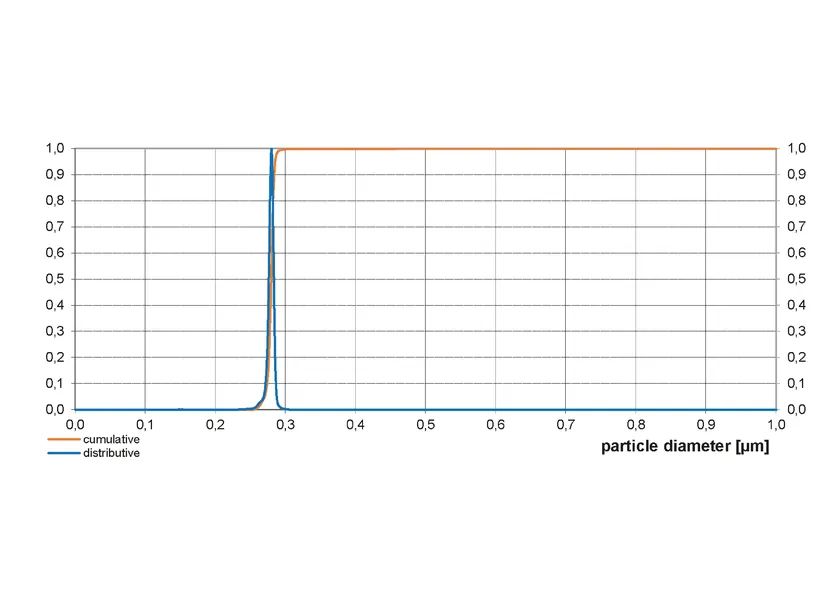
Research grade suspensions 2
Concentrated polymer microsphere suspensions at 10% w/w, with a narrow monomodal distribution (CV ≤ 5%) and an accurately measured diameter, for applications that need large amounts of material but not SI traceability. Diameters range from below 0.1 to above 100 µm and are usually not round values: for example 0.281 µm for a 0.280 µm nominal size. The most common use is filter testing, HEPA included, for exclusion limits and loading capacity; they also serve in sedimentation and centrifugation experiments and as calibrated spacers. 15 or 100 mL bottles, 36 month shelf life at room temperature.
Series technical data
| Material | Polymer (polystyrene) microspheres, monomodal distribution |
|---|---|
| Form | Concentrated aqueous suspension (powder on request) |
| Solids | 10% w/w (gravimetric) |
| Uniformity | CV ≤ 5% |
| Diameters | From below 0.1 to above 100 µm; values usually not rounded |
| Traceability | Not traceable to SI (traceability on request) |
| Packs | 15 mL or 100 mL |
| Shelf life | 36 months from the date of manufacture |
| Storage | Room temperature (4-30 °C) |
| On request | Surface modification, fluorescent labelling, custom concentrations |
Research grade suspensions0.1-100 µmResearch Grade Monomodal Polymer Microsphere Suspension 0.1-100 µm ≤5% CVCat. No. 60xxx-15Pack size 15 mLPrice Research grade suspensions0.1-100 µmResearch Grade Monomodal Polymer Microsphere Suspension 0.1-100 µm ≤5% CVCat. No. 60xxx-100Pack size 100 mLPrice Frequently asked questions
Are the standards traceable?
Yes: mean diameter, standard deviation and uncertainty are traceable to NIST and the International System of Units (SI) and stated on the certificate of every lot. The ISO/IEC 17025 series is certified by an accredited metrology laboratory.
Which control do I need for USP <788>?
For subvisible particle counting in injectables, use the PharmaCount controls: the USP <788> set for routine verification, the 3M and PC sets for single diameters. For USP <729> there is PharmaCount BiCal.
Can I order a diameter I do not see?
Yes: other diameters, concentrations and dyes are available on request. Tell us the value you need and we will send a quote.
How do I see the prices?
List prices per pack, excluding VAT, are shown after signing in to the customer area. With the quote request we confirm price, availability and delivery time.